History · August 19, 2026
The History of Potato Flakes
Before a potato flake ever reached an industrial bag with moisture specified to a tenth of a percent, it travelled a road spanning several centuries — from Andean terraces, through two world wars, to a priority dispute between a laboratory in Philadelphia and Canada's Department of Agriculture. This is the story of one of the most unassuming, yet most influential, food inventions of the 20th century.
Frozen Tubers, Five Centuries Old
The oldest known method of preserving potatoes was developed by the Inca in the Andes, at altitudes where nights are freezing and days are sun-drenched. Thinly sliced tubers were left out overnight to freeze, then hand-scraped of ice crystals each morning — repeated for several days running, until the raw material lost nearly all its moisture. The result, called chuño, could be stored for years and served as a military and emergency food reserve for the Inca Empire.
A similar intuition, in a very different climate, was shared by the people of northern Japan — the Ainu froze potatoes gathered in early spring, soaked them, mashed them into a paste, and formed them into balls cooked over a fire. Chuño is still sold in markets across Bolivia and Peru today — it is arguably the longest continuously produced dehydrated potato product in the world.
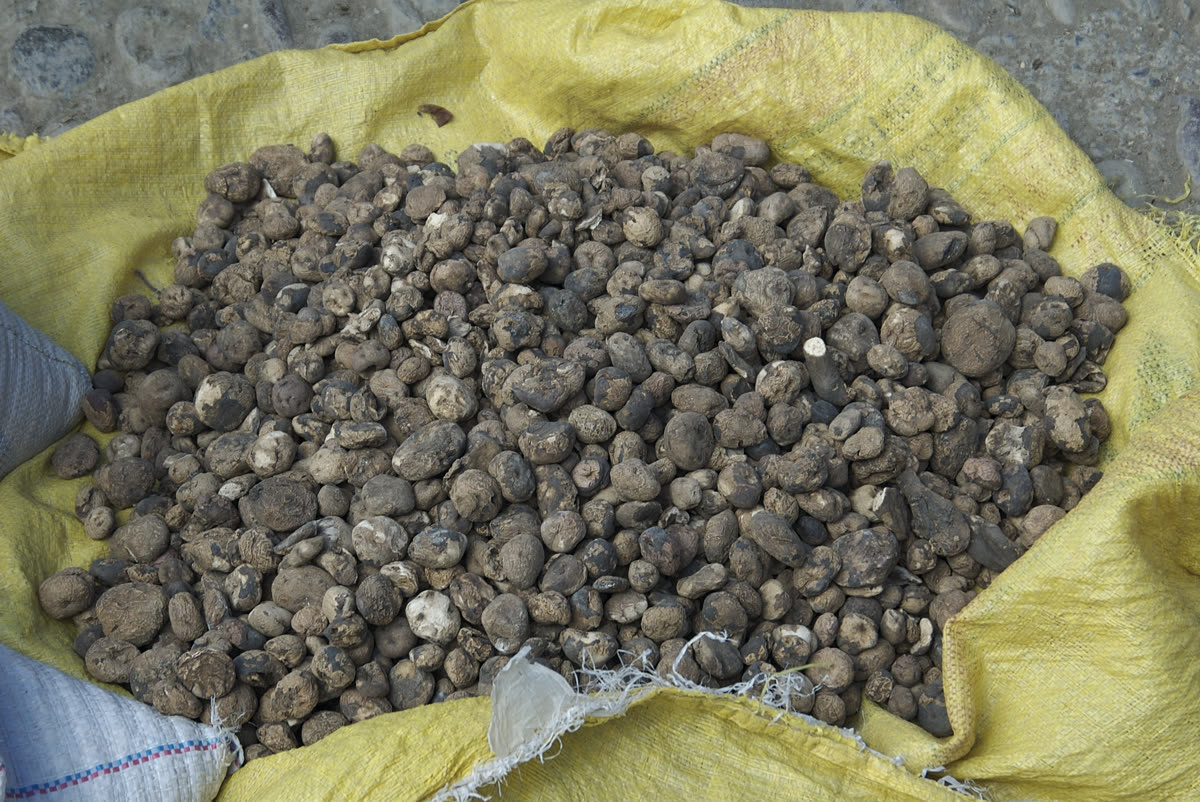
Chuño prepared today using the same method as five hundred years ago. Photo: Eric in SF / Wikimedia Commons (CC BY-SA 3.0)
The First Patent That Didn't Quite Work
The modern story begins in 1905, when American inventor Ernest W. Cooke filed a patent for a potato dehydration process (granted in 1912). The method involved cutting, shredding, lightly cooking and drying the potatoes — in theory, the product could later be reconstituted with water. In practice, early drying technologies destroyed the tuber's cellular structure: the resulting powder was coarse, floury, and lost the characteristic potato flavour. A real breakthrough was still half a century away.
The War That Taught the World to Dry Potatoes
Demand for dehydrated vegetables, including potatoes, surged during World War I — armies needed a lightweight, non-perishable source of starch for soldiers at the front. After the war, interest faded almost as quickly as it had grown.
Truly systematic research didn't begin until World War II. In the United States, two laboratories of the Department of Agriculture (USDA) took up the challenge: the Western Regional Research Laboratory in Albany, California, and the Eastern Regional Research Laboratory in Philadelphia — the former published a technical bulletin on dehydrated white potatoes as early as June 1943. Colonel Paul Logan, responsible for developing field rations, personally championed the introduction of dehydrated potatoes and onions into U.S. Army provisions.
On the other side of the Atlantic, the war was fought over potato cultivation itself. Britain's Ministry of Food created a cartoon mascot, Potato Pete — a cheerful, tuber-shaped character who urged Britons from posters to eat more potatoes instead of rationed bread and meat. It wasn't a campaign about dehydration, but about the same underlying problem: how to feed a nation on limited resources, with one of Europe's most calorie-efficient crops close at hand.
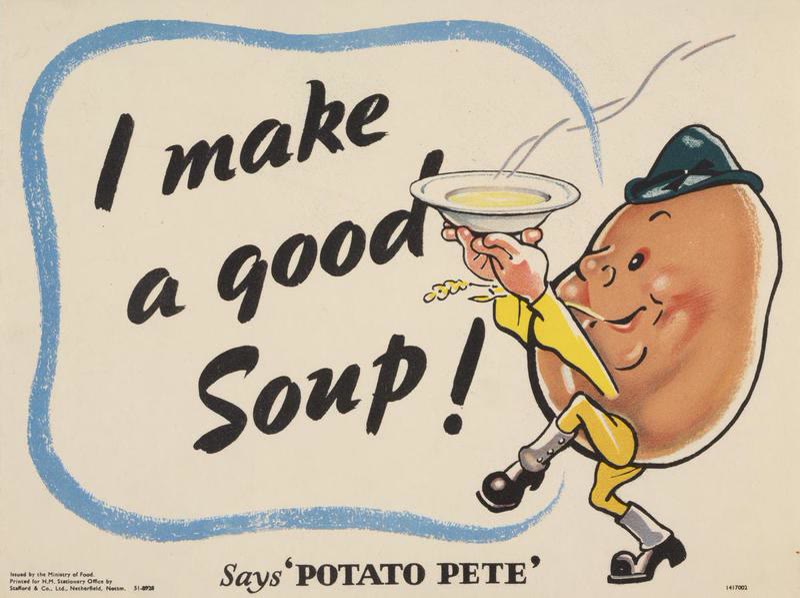
A British Ministry of Food poster from World War II. Public domain.
The Race for Priority: Philadelphia, Idaho, and Ontario
At the turn of the 1940s and '50s, the Western Regional Research Laboratory developed a potato granule process — the first dehydrated product to genuinely reach store shelves. In the early 1950s, the R.T. French Company (known today for its mustard, as French's) commercialised it under its own brand as ready-made instant mash.
In parallel, at the USDA laboratory in Philadelphia, engineer Miles Willard was working on an entirely different method: cooking, drum-drying, and lifting off a thin sheet in flake form rather than granules. In 1955, Willard relocated to Idaho, where he designed and operated for the Rogers Brothers Company what industry historians call the world's first commercial potato flake plant (some sources place full start-up in 1957). Idaho, until then associated mainly with fresh table potatoes, became from that moment the heart of America's potato processing industry.
A few years later, in 1961, three scientists from Canada's Department of Agriculture — Edward Asselbergs, Hugh Hamilton, and Patricia Saidak — filed a patent (granted in 1962) for a refined version of the same idea: potatoes were cooked, "fluffed" to remove excess moisture, then rolled between drums into thin, perforated sheets. The result tasted and dissolved noticeably better than the earlier granules — and it was this method that, over the following decade, came to dominate the consumer market in North America.
So Who Actually Invented Potato Flakes?
Historians of the industry still disagree. Popular media almost unanimously credit Edward Asselbergs as the "inventor of instant mashed potatoes" — and it's easy to see why, since his patented method defined the taste and texture we associate with flakes today. Food technology historians, however, point out that it was Miles Willard and his team at the USDA who launched the first commercial flake production — six years earlier, in Idaho.
One detail worth adding rarely makes it into popular accounts: Asselbergs wasn't designing his method purely for the convenience of the American homemaker. He wanted a product that could be easily fortified with protein and shipped as food aid to regions suffering from malnutrition — a goal that, given today's global flake exports to dozens of countries, sounds strikingly relevant.
From Military Rations to a Global Market
Today, an industry that began with military rations and experiments in government laboratories includes several global players — McCain Foods, Basic American Foods, Lamb Weston, Idahoan Foods, and European producers such as Aviko and Emsland Group, which we covered in our earlier analysis of the European market. The technology itself — cooking, drum-drying, moisture control — has changed surprisingly little in seventy years. What has evolved the most is precision: today's production lines hold parameters within tolerances the postwar pioneers could only have dreamed of.
It's from this postwar tradition — batch-after-batch consistency, regardless of where the raw material comes from — that the standard we look for in every shipment of potato flakes and starch we arrange for our customers is derived.